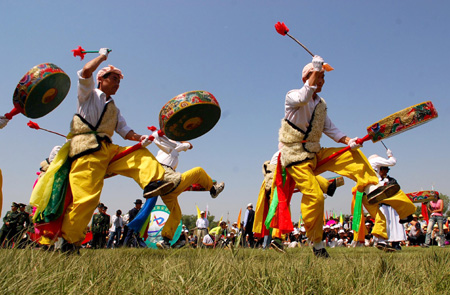
Nadun Festival
Introduction
The Nadun Festival is a vibrant and culturally rich celebration held by the Tu ethnic group, primarily in Northwest China's Qinghai province. This festival, often referred to as "the world's longest carnival", spans over two months, from the 12th day of the seventh month to the 15th day of the ninth month on the Chinese calendar. During this period, the community and visitors experience a flourish of colorful flags, traditional costumes, song and dance performances, and the resounding beats of gongs and drums. The festival represents a time of cultural celebration and community bonding, deeply rooted in the agricultural traditions of the Tu people.
History
The origins of the Nadun Festival can be traced back to the late Yuan Dynasty (1271-1368) and early Ming Dynasty (1368-1644). During this period, the Tu ethnic group transitioned from a nomadic lifestyle to permanent settlement, engaging in farming and livestock breeding. This shift in lifestyle necessitated community cooperation, which was initially facilitated by temple fairs designed to resolve agricultural disputes and foster harmonious relations. Over time, these fairs evolved into the grand carnival format of the Nadun Festival, marked by collaboration between villages where one hosts and the other acts as a guest, a tradition that continues to this day. This historical evolution reflects the festival's enduring significance in promoting unity and celebrating the harvest within the Tu community.
Cultural Significance
Nadun, meaning "having fun" and "entertaining" in the language of the Tu people, is more than just a festival; it is an integral cultural celebration that underscores the community's agricultural heritage. Unlike the Mongolian Naadam festival, which highlights athletic prowess through the "Three Games of Men", Nadun focuses on village-level temple fairs characterized by mask dances, opera performances, and sacrificial offerings. These activities celebrate the abundant harvest and express gratitude for prosperity and good fortune. Designated as a National Intangible Cultural Heritage in 2006, the festival is a testimony to the Tu people's creative endeavors in fostering a harmonious community through cultural expression and shared joy.
Traditional Activities
Rituals
The Nadun Festival begins well before its official start date, with preparations commencing as early as Tomb-Sweeping Day in April. The residents prepare sacrifices to deities as well as other local gods. This preparatory phase involves electing festival leaders responsible for organizing events and coordinating village activities. As the festival approaches, small meetings are held in tents where villagers offer sacrifices. On the final day of preparations, the festival's commencement is announced with the beating of gongs and drums.
Music and Dance
Music and dance are pivotal elements of the Nadun Festival, highlighting the rich cultural heritage of the Tu ethnic group. Traditional music sets the stage for village dances, where participants move rhythmically in circles, swaying from left to right. The mask dance, or "Nuo dance," is a distinctive feature that often concludes the carnival. These dances, such as "Crops Qi", "Five Generals", and "The General who Killed Tigers", dramatize ancestral stories of farming and animal husbandry, celebrating the resilience and optimism of the Tu people. The dance serves as an invitation for the gods to join in the festivities, symbolizing the interconnectedness of the divine and human realms.
Modern Celebrations
Today, the Nadun Festival continues to be a cornerstone of cultural identity for the Tu ethnic community. While retaining its traditional elements, the festival has adapted to contemporary times, welcoming an increasing number of tourists who are drawn to its unique cultural displays. This modern iteration of the festival serves not only as a celebration of Tu heritage but also as a platform for cultural exchange and tourism, contributing to the region's cultural and economic vitality.








